Anyone who has tried to pull Google search results in serious volume hits the same wall around request 200.
The IP gets flagged, a reCAPTCHA wall drops in, and the script that worked fine in testing now needs a proxy pool, a solver service, and someone to watch it.
Pulling a few queries for a side project is one thing.
Running rank tracking, ad monitoring, or a brand visibility dashboard against millions of keywords is a different sport entirely.
This is where a developer-friendly SERP API earns its keep, since it removes the scraping headache and hands you structured data instead of raw HTML you still have to fight.
Why Scraping Google Yourself Gets Expensive Fast
Google does not want bots on its search results page, and it has gotten very good at spotting them.
The HTML structure shifts often enough that CSS selectors written last month tend to break this month.
New SERP features keep appearing: featured snippets, People Also Ask boxes, shopping carousels, AI overviews, and video packs.
Each one has its own parsing quirks, and each one breaks when Google decides to redesign it.
A team that builds its own scraper is signing up to maintain a parser, a proxy rotation system, a retry queue, and a CAPTCHA workflow.
That’s four side projects nobody asked for.
What a SERP API Actually Returns
A SERP API treats Google as a structured data source instead of a webpage you have to fight.
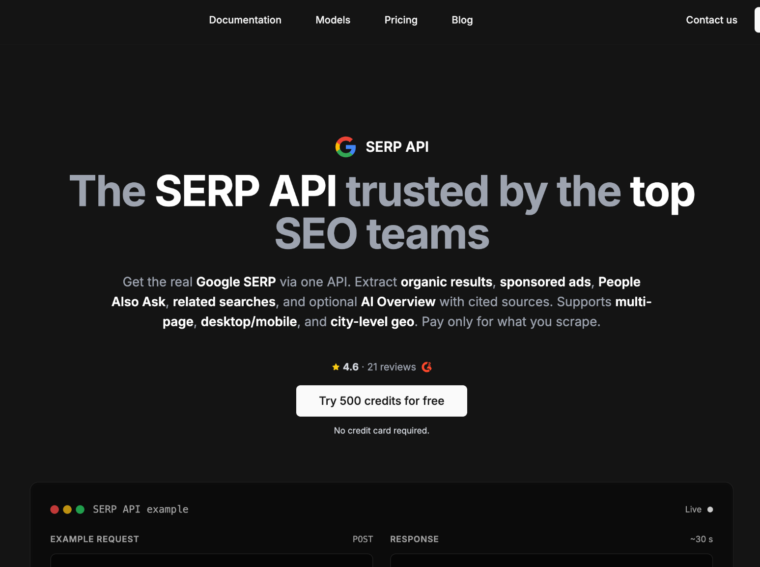
You send a query, the service handles the scraping infrastructure, and you get back clean JSON with organic results, paid ads, knowledge panels, related searches, and whatever else appeared on the page.
Proxy rotation, CAPTCHA solving, and parser maintenance all sit on the vendor’s side.
Your code makes an HTTP call and parses a predictable response.
That predictability is the whole point, because it lets you build features on top of search data without inheriting an ops problem.
The Cost Math Most Teams Get Wrong
The cost math is usually where teams change their mind about building in-house.
A decent residential proxy pool runs a few hundred dollars a month minimum.
A CAPTCHA-solving service adds more on top.
Add an engineer’s time for monitoring, debugging broken selectors, and chasing edge cases, and the “free” scraper costs five figures a year before it returns a single useful result.
A managed API charges per successful query and removes the headcount cost entirely.
For most teams below a few million queries a month, the math is not close.
What Makes One Service Better Than Another
What separates a usable service from a frustrating one comes down to a few practical things.
Response shape matters first, since a JSON layout that mutates every time Google redesigns a feature still leaves you maintaining a parser, just one step removed.
Geographic targeting matters too, because pulling results from New York and pulling them from São Paulo should both work without setting up local proxies yourself.
Latency matters when you’re powering a live dashboard.
Device targeting, desktop versus mobile, matters because the two result pages can look completely different for the same query.
Vendors like cloro.dev and a handful of others in the space tend to compete on exactly these axes, so running a few test queries against two or three providers is the fastest way to figure out which one fits your stack.
The first hour with a service usually tells you everything: either the auth flow is straightforward, and the error messages are useful, or you’re digging through forum threads to figure out why your status code is 200, but the body is empty.
Common Use Cases Beyond Rank Tracking
The use cases for SERP data are wider than keyword position tracking.
- SEO teams monitor keyword positions across regions and devices.
- PPC teams watch competitor ad copy, ad extensions, and the positions competitors are bidding for.
- E-commerce companies pull shopping results to track pricing and seller visibility on Google Shopping.
- Research firms run SERP feature analysis: what percentage of queries in a given industry now show an AI overview, how often Reddit threads appear on page one, and where Quora has lost ground.
- Sales teams surface prospects who rank for specific commercial intent queries, then use that signal to prioritise outreach.
All of these workflows depend on the same thing: getting search results reliably, in volume, without paying an engineer to babysit a scraper.
When Building In-House Still Makes Sense
The honest case for building your own scraper is narrow.
If you have unusual requirements that no vendor supports, or if you’re running query volumes large enough that per-query pricing stops making sense, in-house can win.
There is also a case for it when the data is so sensitive that sending queries through a third party is a non-starter.
For everyone else, the buy-versus-build conversation usually ends the same way.
Google fights back hard enough that scraping is no longer a weekend project, and the opportunity cost of having engineers maintain a scraper instead of shipping actual product features is real.
A SERP API turns a moving target into a stable input, which is the only reason rank trackers, market intelligence platforms, and modern SEO suites can operate at the scale they do.