
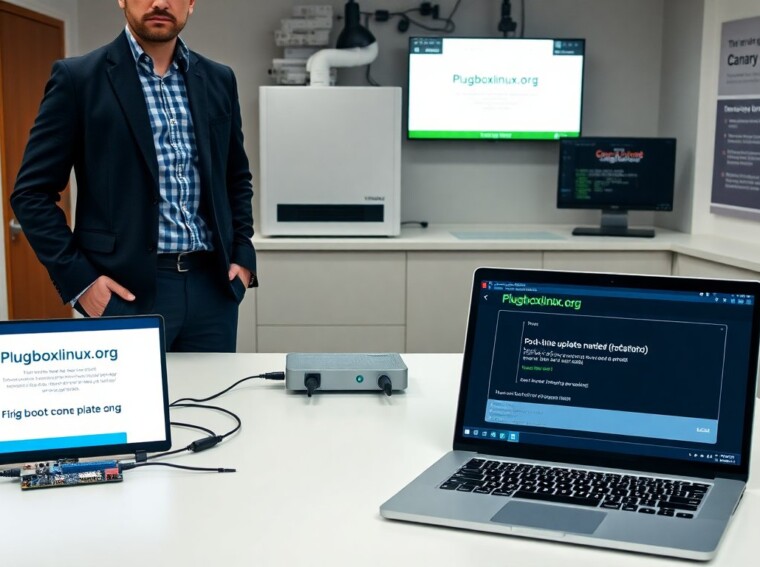
plugboxlinux.org offers a minimal Linux distribution built for edge devices and appliances. It targets developers, integrators, and operators who need small footprints and fast boot times. The project focuses on security, predictable updates, and low resource use. This guide explains what plugboxlinux.org provides, how it performs, how to install it, and how to maintain it in production.
Key Takeaways
- Plugboxlinux.org is a minimal Linux distribution optimized for edge devices and appliances, emphasizing small footprint, security, and fast boot.
- It features atomic updates, image-based deployments, and application isolation using containers or sandboxes, enhancing security and maintainability.
- Installation involves verifying signed images and configuring devices with simple tools suitable for ARM and x86 hardware with minimal resource requirements.
- Maintenance relies on image-based updates with atomic rollbacks, timely security patches, and long-term support tracks for stable production environments.
- The project supports a strong community with public forums, issue trackers, and paid support, encouraging developers and operators to contribute and share CI pipelines.
What PlugboxLinux.org Is And Who Should Use It
plugboxlinux.org is a compact Linux distribution. It uses a minimal userland and a hardened kernel. It targets devices with limited CPU, memory, and storage. It suits appliance makers who need predictable boots. It suits engineers who need a secure base for IoT gateways, kiosks, routers, and embedded controllers. It suits teams that want reproducible images and small attack surface.
It provides a simple package model. It offers atomic updates and image-based deployments. It reduces runtime services to essentials. It isolates applications with containers or sandboxes. It integrates with common tooling such as systemd units or lightweight init systems. It supports cross-compilation workflows and image customization.
Companies choose plugboxlinux.org when they need long-term stability and small overhead. Hobbyists pick it when they want a focused runtime for a single application. Integrators pick it when they must meet regulatory or certification requirements that favor small, auditable software stacks.
Core Features, Architecture, And Performance Highlights
plugboxlinux.org centers on three core goals: small footprint, security, and fast boot. The distribution ships a stripped userland that keeps images under tens of megabytes. It uses a hardened kernel configuration and selective module loading. It employs seccomp and namespace isolation to limit process capabilities.
The architecture splits the system into a base image and application layers. The base image contains the kernel, init, and core tools. The application layers run in isolated units. This split lets teams update apps without rebuilding the entire image. It also helps rollback after a failed update.
Performance tests show quick boot times and low memory use. On typical ARM boards, plugboxlinux.org boots in seconds and uses under 100 MB of RAM with a single service. On x86 appliances, it keeps CPU overhead low under steady loads. The image model permits compression and delta updates. The update model reduces bandwidth use by sending only changed blocks.
Security features include signed images, verification at boot, and reproducible builds. The project publishes checksums and GPG-signed releases. It encourages minimal packages and static linking where appropriate. It also documents recommended kernel hardening options and secure default sysctl values.
Installing PlugboxLinux: Requirements, Images, And Step-By-Step Overview
plugboxlinux.org provides prebuilt images and build scripts. It supports ARM and x86 targets. It lists minimal hardware requirements on the download page. A typical target needs a bootloader, 128 MB to 256 MB flash, and a network or serial console for first boot.
Step 1: Download the correct image for the target. The site names images by architecture and device type. Step 2: Verify the image signature against the provided GPG key. Step 3: Write the image to media with dd or a verified flasher. The project documents recommended block sizes and sync steps.
Step 4: Configure the device at first boot. The system uses a simple config file for network, hostname, and keys. The installer or cloud-init style hooks inject SSH keys or provisioning tokens. Step 5: Deploy the application layer. Teams can use container images, single binaries, or packages provided by the project.
For custom builds, the project supplies a minimal SDK and cross-compile toolchain. The SDK exports a reproducible build recipe. Developers adjust the recipe and run the build on a supported host. The guide shows how to generate compressed images and how to test them in qemu before flashing hardware.
Maintenance, Security Practices, And Community Support Options
plugboxlinux.org recommends an image-based maintenance model. Teams rebuild and sign images for each release. They test images in CI and stage them in a canary pool before wide rollout. This method allows atomic rollbacks and consistent hosts.
Security practices include timely patching, minimal packages, and signed updates. Operators run regular image scans for CVEs and rebuild images when critical fixes appear. The project lists a security contact and an advisory page. It also supports long-term support (LTS) tracks for stable deployments.
For monitoring, plugboxlinux.org suggests lightweight telemetry that sends health metrics and logs. The guide shows how to use secure transport and key rotation. It also documents recommended firewall and SELinux/AppArmor settings.
Community support options include a public forum, an issue tracker, and paid support plans from third-party integrators. The forum contains device-specific threads and contributed device profiles. The issue tracker logs bugs, feature requests, and security advisories. Paid plans offer SLAs, custom images, and integration help for businesses.
Developers and operators can join the community to share device recipes and CI pipelines. The project welcomes patches and reproducible build contributions. It also provides templates for compliance documentation and device attestations.
